Located at Nilachal Hill in Guwahati, Assam, the Kamakhya Temple stands as a revered pilgrimage site, distinguished as one of the 51 Shakti Peethas in Hinduism. Amidst a cultural landscape where discussions surrounding menstruation remain somewhat taboo, this temple boldly breaks conventions by openly celebrating the biological process of menstruation and womanhood.
Kamakhya Temple uniquely honours menstruation, knowing it as a natural and powerful aspect of every woman's life : a symbol of fertility and the continuation of humanity. The deity and temple embody the essence of 'Shakti,' signifying the inherent power within each woman.
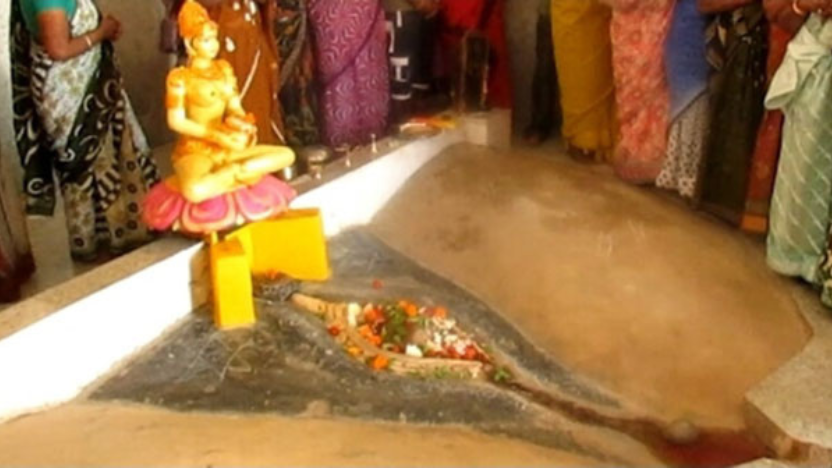
Unlike conventional temples, Kamakhya does not house an image or idol of the deity. Instead, a sculptured stone symbolising 'Yoni,' representing the female genitalia, takes center stage. Kept moist by the natural spring within the cave, this stone becomes the focal point for offerings, with flowers and leaves distributed among devotees.
According to Hindu mythology, the origins of Goddess Kamakhya are closely linked to the story of Goddess Sati. When Sati immolated herself after being unable to bear the humiliation directed at her husband, Lord Shiva, the grief-stricken deity carried her body across the universe. To restore cosmic balance, Lord Vishnu used his Sudarshan Chakra to dismember Sati's body, and the places where her body parts fell became sacred Shakti Peethas. It is believed that Sati's yoni (womb and generative organ) fell at Nilachal Hill, making Kamakhya the embodiment of feminine power, fertility, and creation itself.
Another legend found in the Yogini Tantra presents Kamakhya as a supreme goddess who manifested to curb the arrogance of Lord Brahma. She created the demon Kesi and later destroyed him, establishing her divine presence at the sacred Yoni Mandala. Through this narrative, Kamakhya is celebrated as the ultimate creative force that governs the universe.
Intriguing Facts about Kamakhya Temple
Each year, during the month of Ashaad, the Brahmaputra River adjacent to the temple reportedly transforms into a reddish hue. This occurrence aligns with the belief that Kamakhya Devi, the temple's deity often referred to as the 'Bleeding Goddess,' is menstruating during this period.
Goddess Shakti's Manifestation
Kamakhya Devi represents the manifestation of 'shakti' in every woman. Legend has it that upon Sati's demise, Lord Vishnu, using his chakra, scattered her body parts across the earth. The location where her reproductive organs fell is now the sacred ground of the Kamakhya temple._18.png)
Origin of the Name
The name 'Kamakhya' finds its roots in Kamadeva, the Hindu god of love. The temple pays homage to Sati's reproductive parts, symbolizing the restoration of Kamadeva's potency, lost due to a curse. In tribute to Sati and to celebrate the universal 'shakti' embodied by women, the deity of Kamakhya Devi was installed.
Symbolic Representation
Notably, the Kamakhya Temple doesn't house an image of Goddess Sati; instead, it reveres the Yoni or female genitalia as the object of veneration.
In traditional iconography, Kamakhya is depicted as a radiant young goddess with six heads and twelve arms, each holding sacred weapons and symbols. Seated upon a lotus above Lord Shiva and accompanied by a lion, she represents the union of masculine and feminine cosmic energies that sustain the universe. It's a symbol of embracing and celebrating the natural cycles of womanhood, cycles that are often considered taboo and kept in silence. Here, we can proudly be ourselves and honour the beauty of being a woman.
Source / Iamge Credit : Pradintime , TripExperienceBlog, Wanderwisdom , Dharmo Rakshathi Rakshitha